
PRESENT
My FMP was carried out at Impulse Audio Lab in Munich, an automotive audio studio working with interactive vehicle sound and software. I started with a brief "drivable music": a music experience that would respond to driving behaviour and vehicle data. My PDP framed three goals: eliciting user values for abstract audio experiences, developing advanced interactive sound prototypes, and finding a valid way to evaluate context-dependent automotive UX.
The direction changed during the project. Impulse had strong technical capability, but the real question was not what could be built out from drivable music, it was what interactive in-car music should mean. Through contextmapping, prototyping, company feedback and a simulator study, the project shifted from adapting music to the drive toward helping drivers find music by listening and feeling. This became In-Tune: a multimodal browsing interface built around one motorised fader, four gestures, three interaction layers and a personal music pipeline underneath.
This redirection was the central learning of my FMP. I entered with a technology-driven idea and let user values, prototype failures, embodied interaction and industry constraints reshape the vision.
User & Society
U&S redirected the project most strongly, and this was deliberate. My PDP set a clear goal: master the elicitation of user values rather than stated needs, since people cannot articulate requirements for experiences that do not yet existn and carry out multiple workshops since I had not done that before. I designed a sensitising booklet and a Lego-based generative workshop to surface memories, routines, frustrations and imagined futures around music in the car. This positions the work in the contextmapping tradition [5], which treats latent values as the primary unit of insight.
The analysis reframed the project. Participants did not talk about music as content; they talked about it as a way of moving through time, reconnecting with the past, regulating the present, preparing for what comes next. The opportunity was no longer to make music react to driving data, but to design an interaction that lets people move through their own musical history and mood without specifying everything in words.


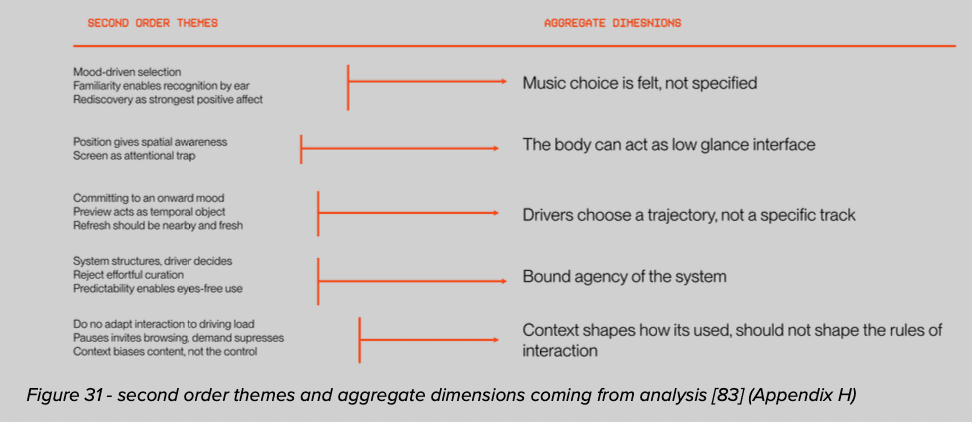
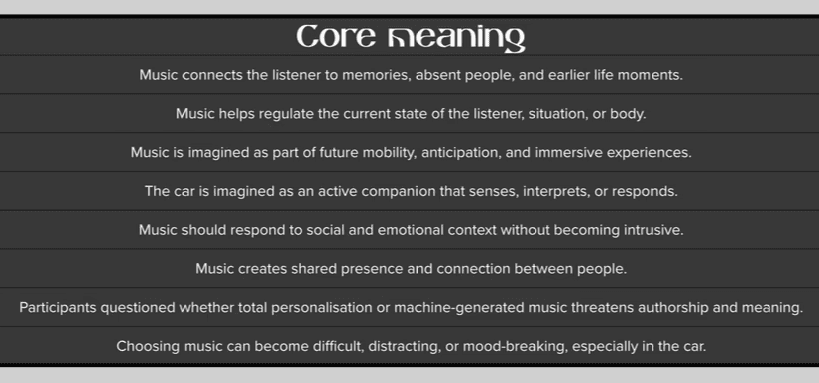
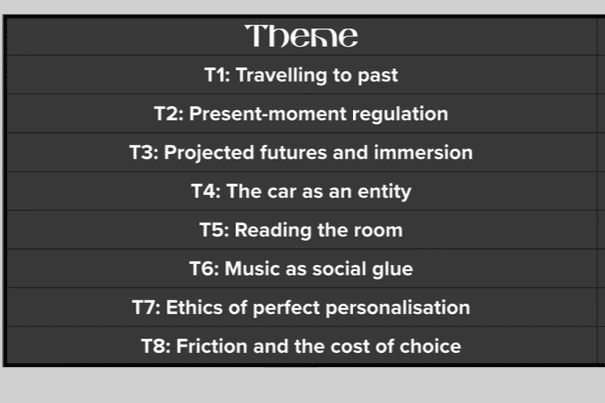
From generative workshop, to extracted themes, concepts, first and secon order dimensiosn

Example of Lego Builds from workshop
The simulator study tested whether this worked in a driving context. Participants selected by mood rather than title, rediscovered forgotten songs, and relied on audio and haptic feedback when the screen became less necessary. The study also exposed limits: too many categories overwhelmed users, dwell-based selection created uncertainty, and screen content still pulled attention from the road. I treated these as design requirements, not population-level proofs. User research had become a way of discovering what the project actually was — exactly the shift my PDP set out to achieve.
Low cognitive load simulator setup
High cognitive load simulator setup
CREATIVITY & AESTHETICS
C&A in the FMP was about turning the personal and emotional side of music into an interaction language that worked using multiple modalities. I learned most from directions that failed. A stem-separation knob that reshaped the playing song was expressive, but interfered with the artist's authored work. A voice-first prototype flattened music into words like "happy" or "calm," while the study showed people often recognise the right song when they hear it but cannot describe it in advance.
Both failures led to the design principle recognition over specification. This is where the multimodal-storyteller identity became concrete. The story is carried by sound, touch and movement rather than by a screen. Haptic detents make moods physically legible, smooth movement supports browsing across tracks, and edge gestures make back, refresh and skip feel like part of one object.
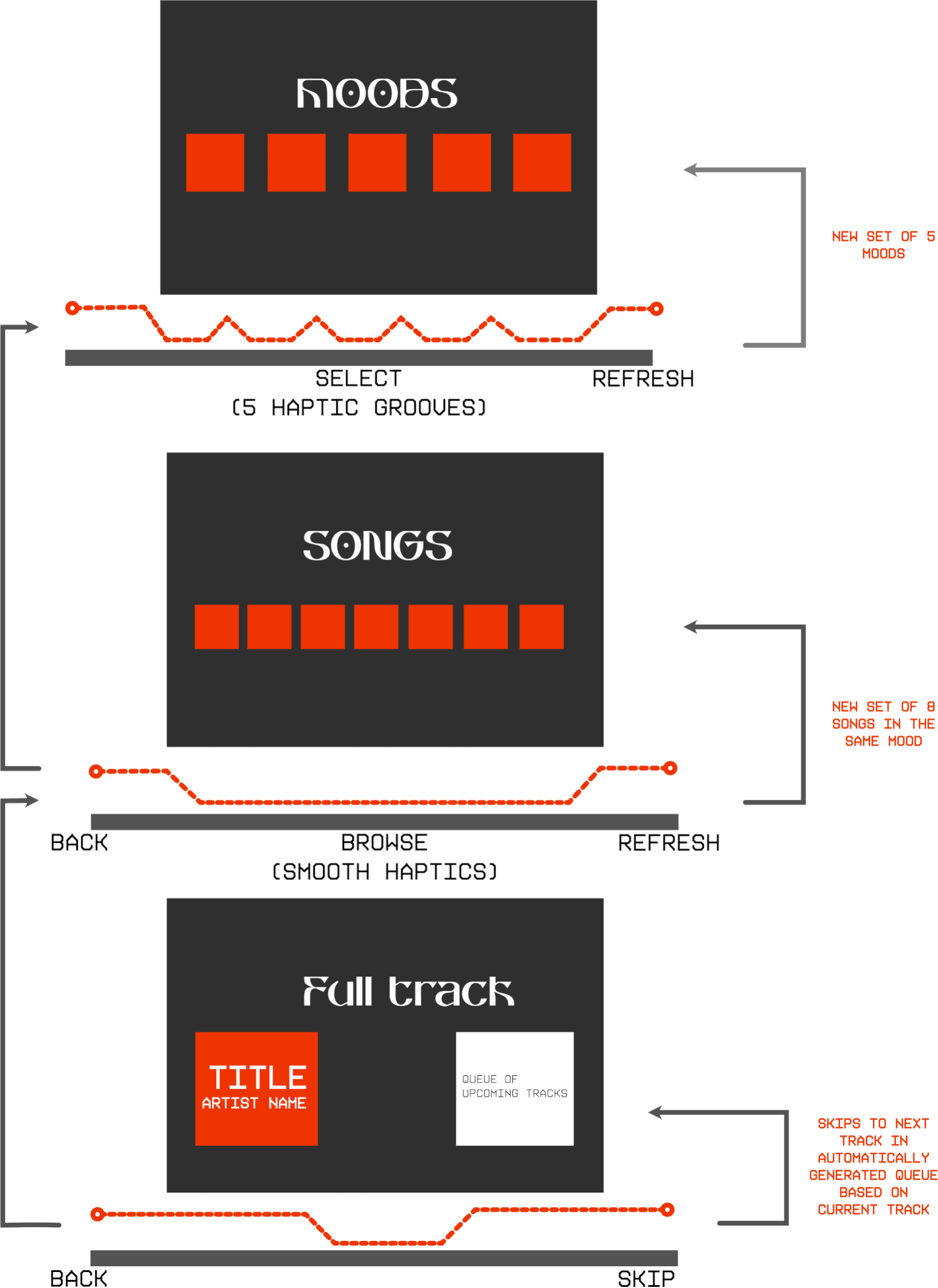
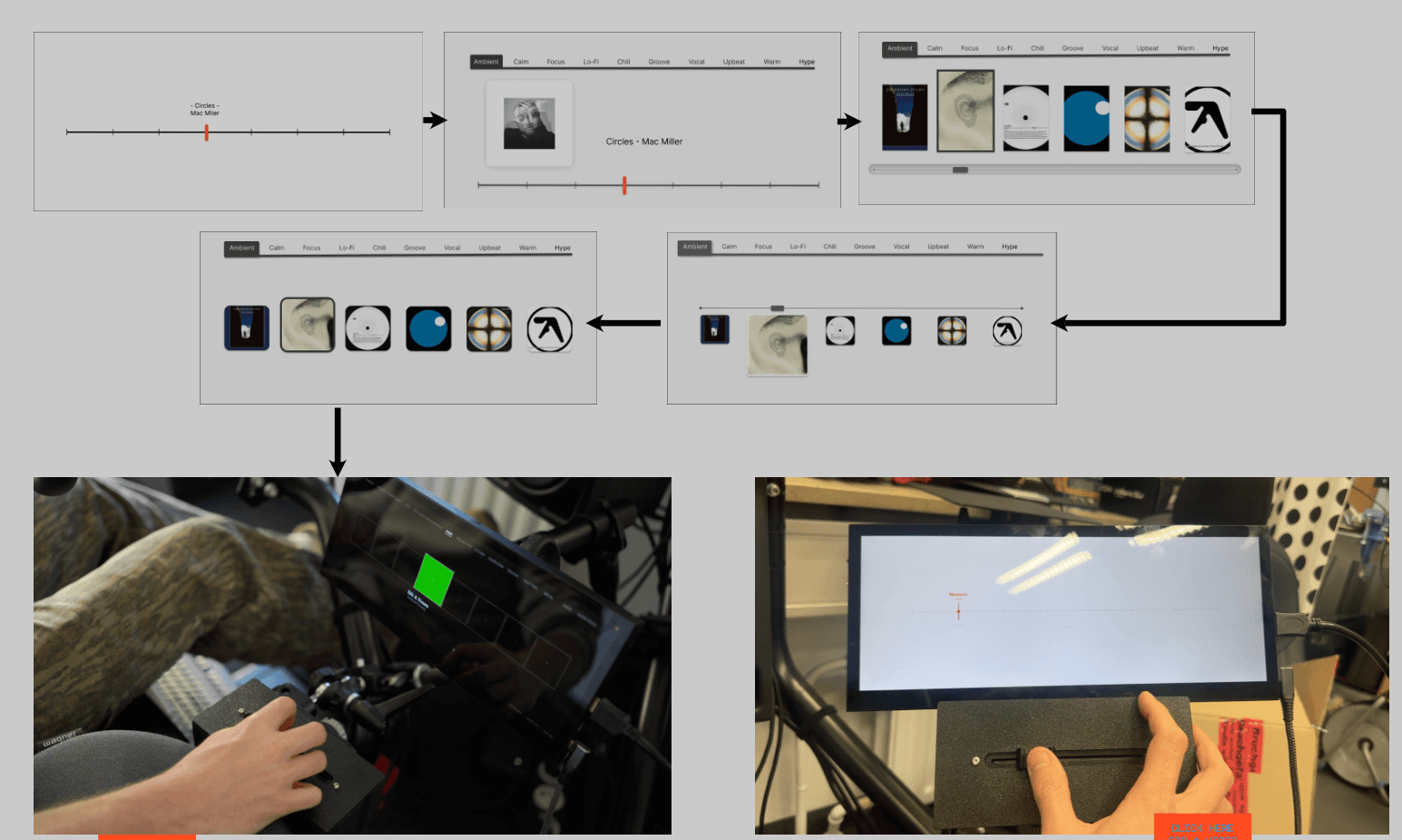
Interacion flow of final design
Final interaction flow with audio.
Subtleties in interaction: panning of audio based on movement of fader
Dynamic Expression: Filter closes down based on speed so sound does not overwhelm
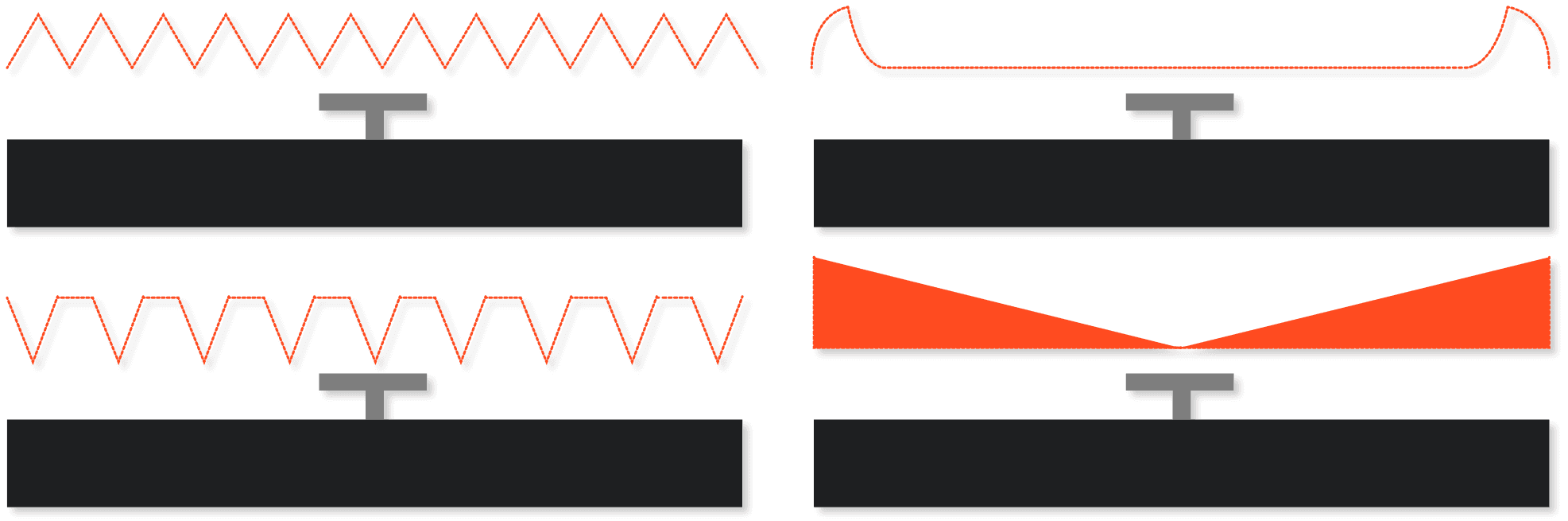
Haptic Patterns, Ui development leading to final aesthetic direction
Technology & Realisation
T&R is central to how I think, and the project confirmed why: I cannot judge an interaction until I can feel it. I built three functional iterations, each reframing the design direction. Ableton and stem separation explored adaptive control over the playing track. A voice-and-playlist prototype explored a narrative drive. p5.js, local audio and a motorised fader explored browsing by sound and touch.
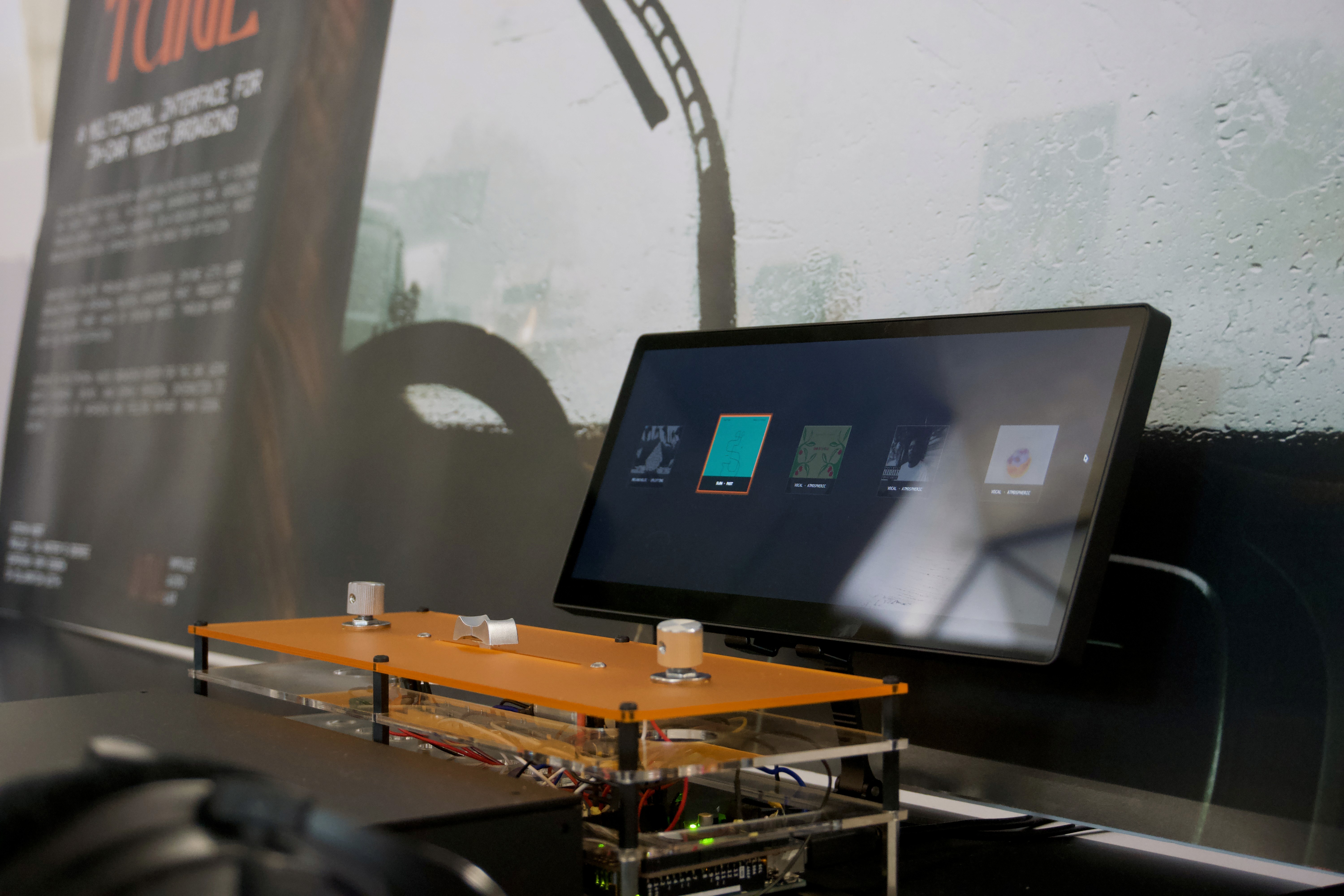
A simple vibrating slider showed that one-dimensional music browsing worked, but the motorised version let me design detents, edge bumps, elastic resistance and layer-specific haptic behaviour. These were not effects added afterwards, they became the interaction language itself. The final demonstrator integrated hardware, software, audio, haptics and a simulator context into a fully experiential prototype.
The project also exposed a weakness I had set as a goal: I build too much myself. I want to keep my technical independence but involve collaborators earlier when systems reach this complexity.
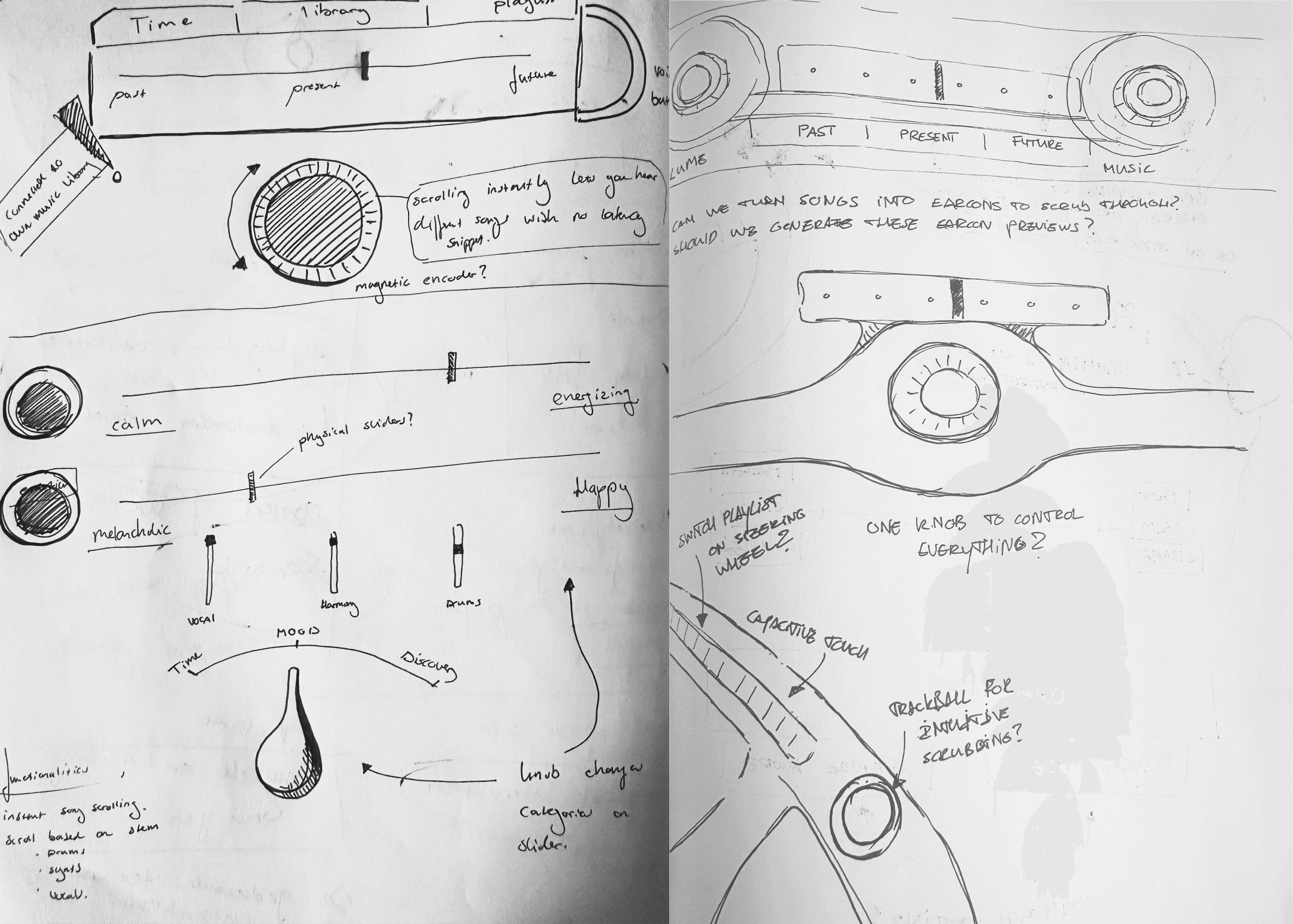
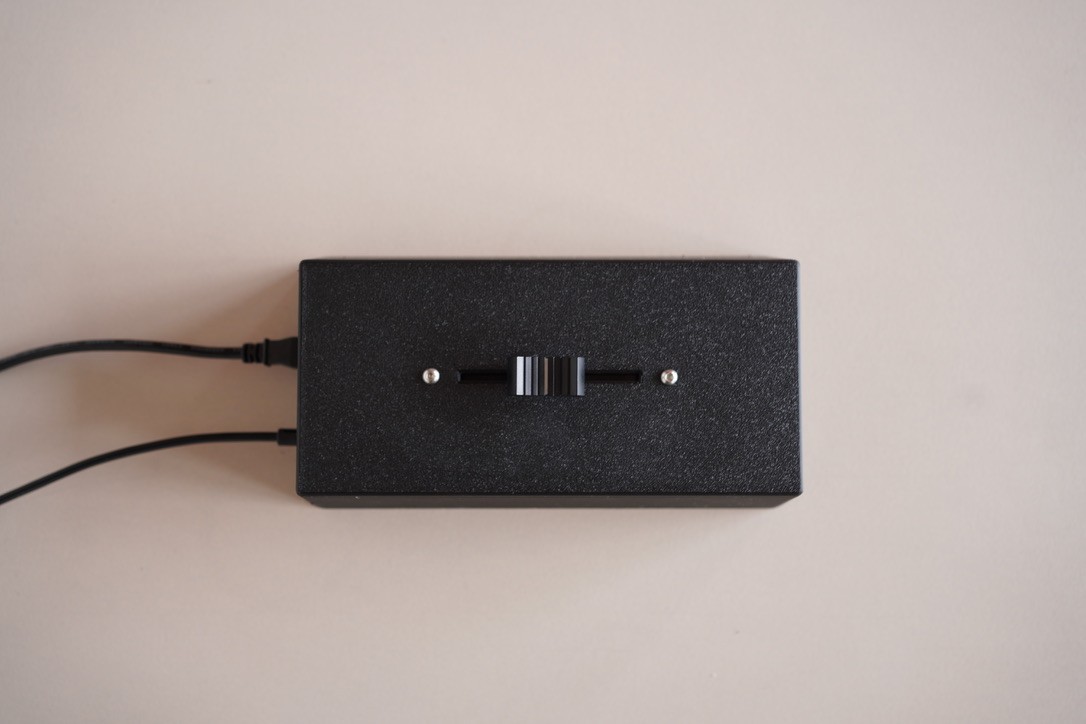
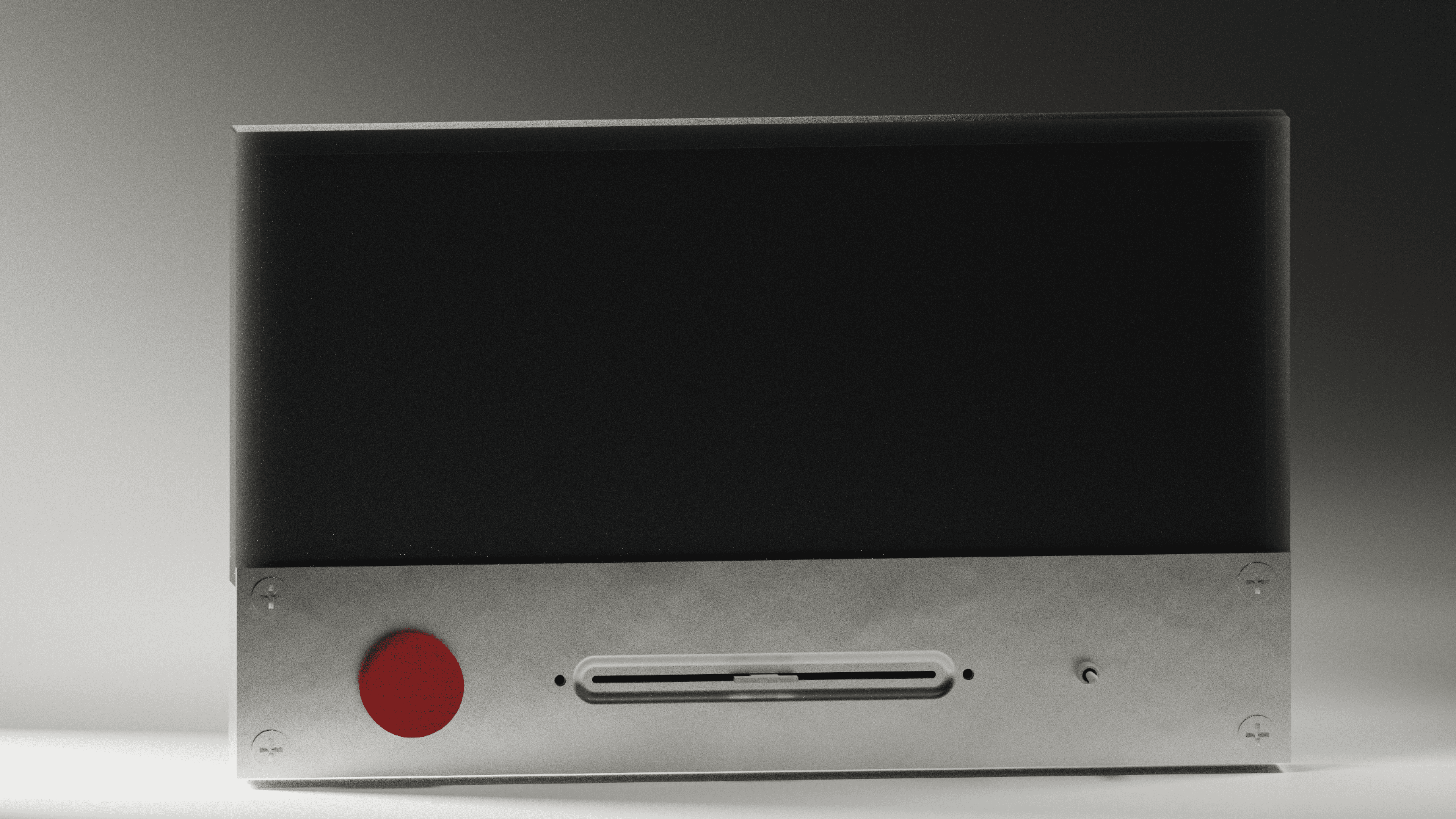


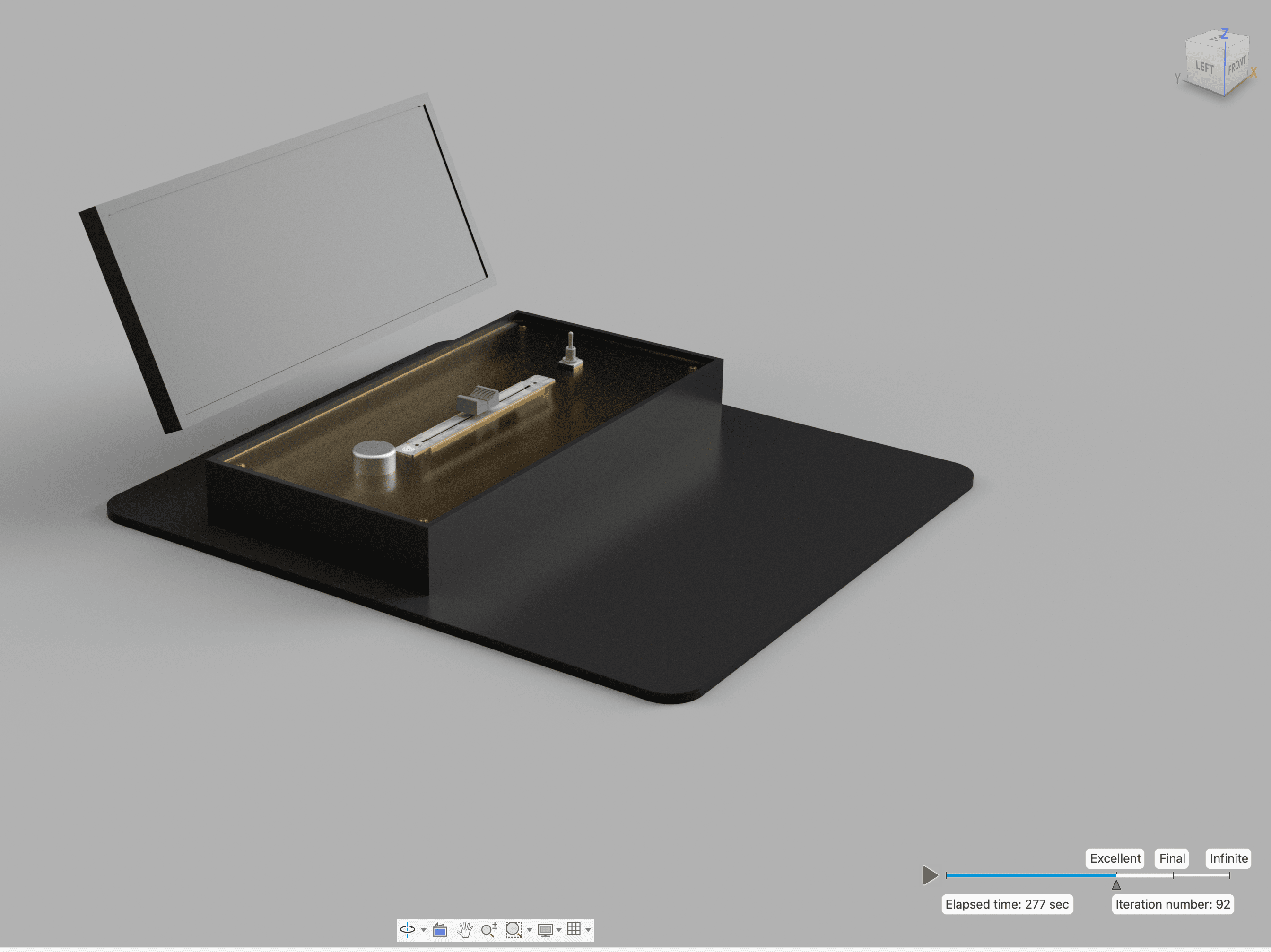
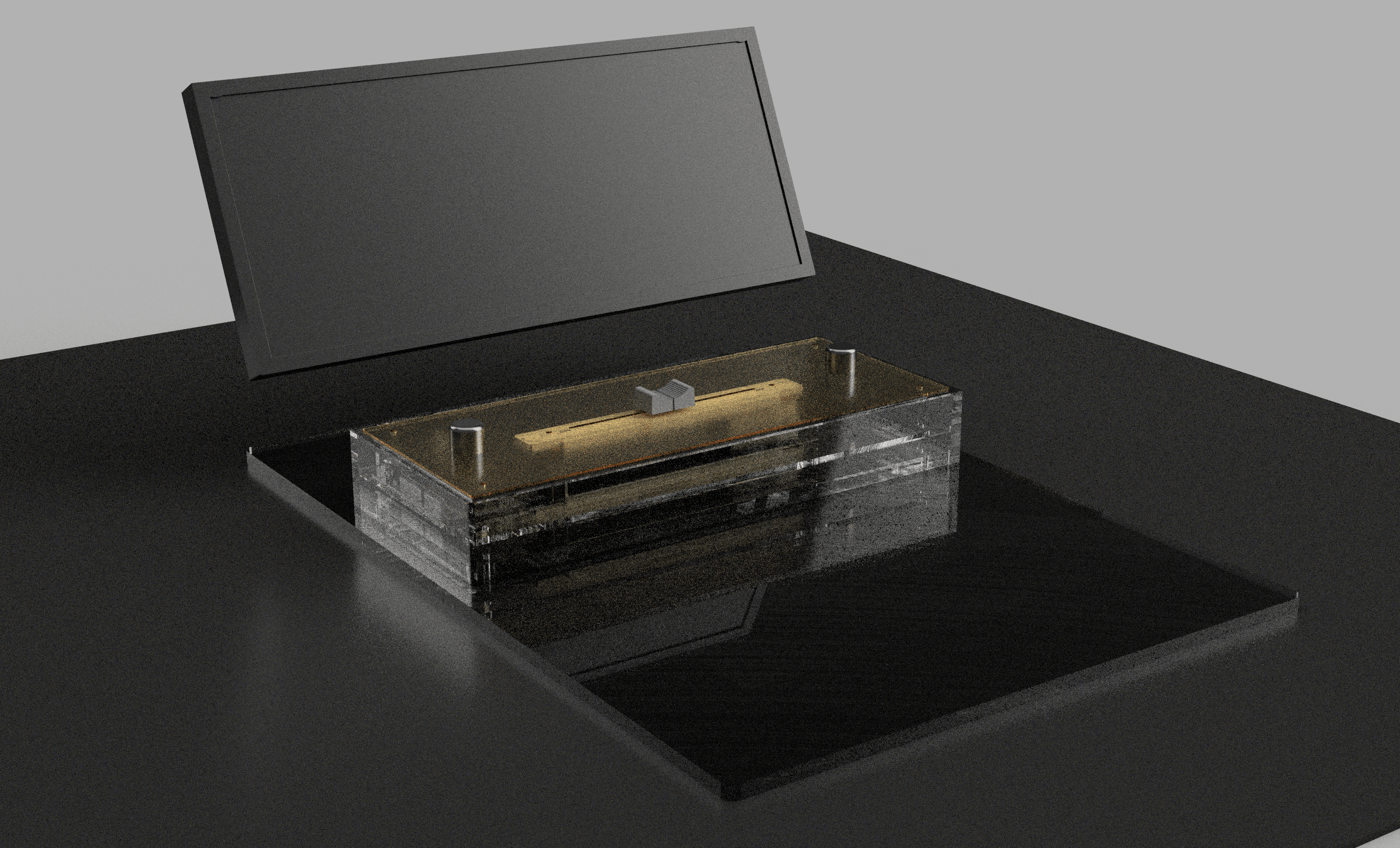
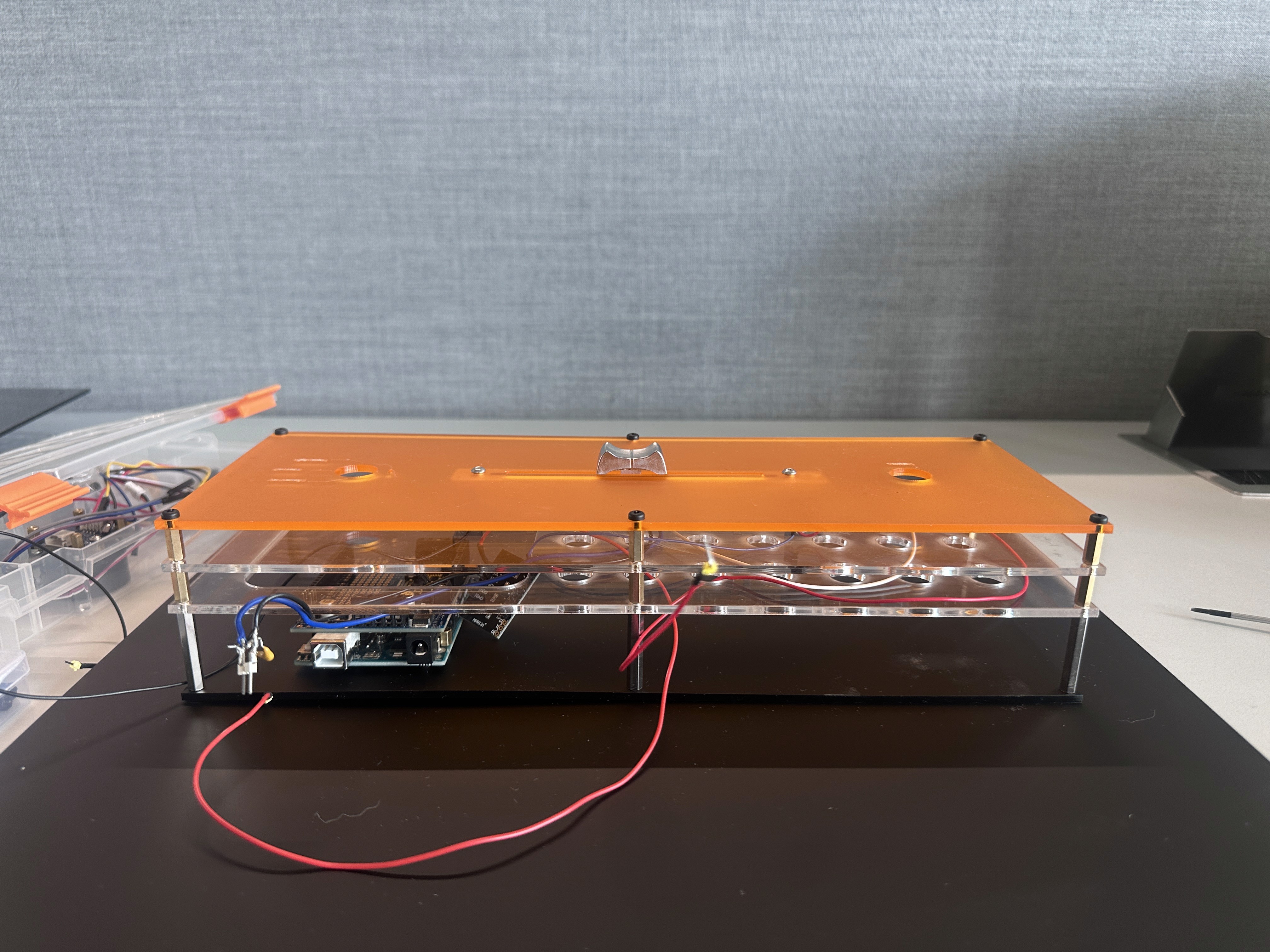
From sketch, to concept in 3D, to physical prototype, to new concept aesthetic, to final design
Math Data & Computing
In-Tune only works if the music under the fader is ordered in a way that feels right. MD&C therefore became design material. I built a pipeline that groups tracks into mood neighbourhoods, filters out songs with little personal relevance, and orders the remainder along an energy axis. This positions the work in the context-aware music recommendation literature, where the field has moved from pure content-based similarity toward context- and listener-aware models [5].
I deliberately did not build a fully autonomous recommender. The system prepares a small, meaningful music space; the driver still chooses by listening. Audio features alone were not enough, because mathematically similar tracks do not always feel musically coherent. As such designing the pipeline became an aesthetic activity, rather then purely mathematical. Listening history mattered because a barely-played song should not weigh the same as one carrying years of personal meaning. The principle: intelligence in the pipeline, simplicity at the interface. Computing handles complexity; the interaction stays embodied and direct.

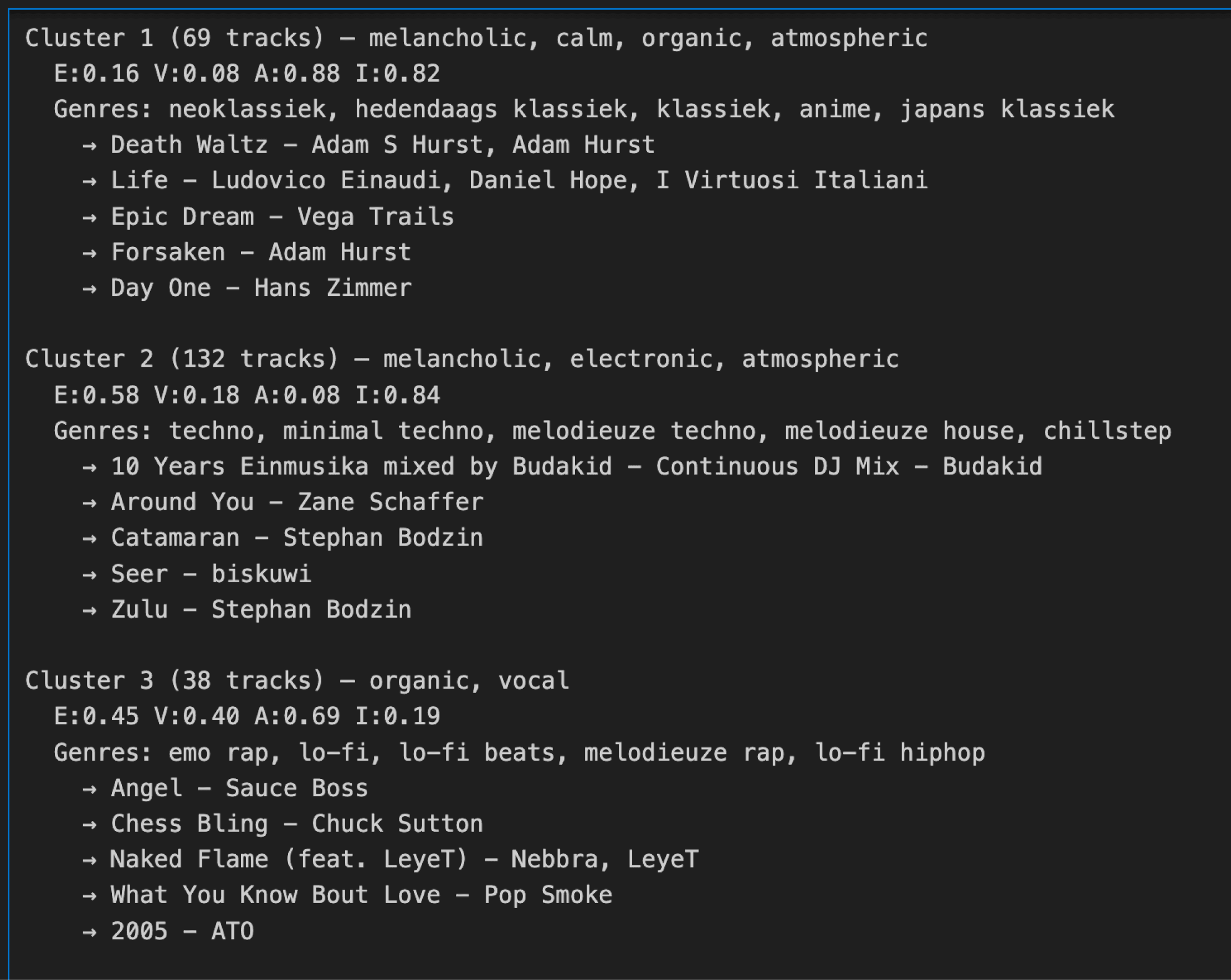
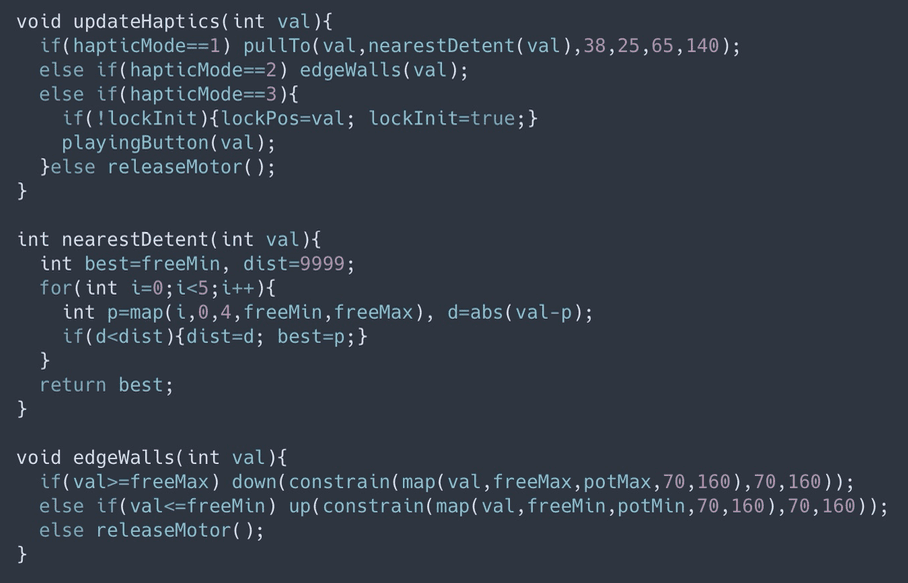
Architecture of pipeline, example output of clusters, manual coded haptic effects
Business & Entreperneurship
B&E in my FMP was about translating an experiential prototype into strategic relevance for a company. Impulse Audio Lab had real automotive ambitions and a real question: how can interactive audio become meaningful for drivers, OEMs and future software-defined vehicles?
In the end, the project delivered something directly useful: a grounded, user-based direction for interactive in-car music, supported by a functional demonstrator and external feedback. Colleagues at Impulse described the topic as relevant to automotive audio, SDV and future product differentiation and pitched to external NDA client who expressed interest [Appendix 1]. Alongside the thesis I contributed to client-facing service projects under NDA, including sound design for in-vehicle earcons for a large international OEM. This gave me direct experience with commercial audio workflows, stakeholder presentations and the difference between academic exploration and industry-facing work. The biggest shift was about feasibility, I stopped treating it as a limitation. Feasibility became constraints to design with.

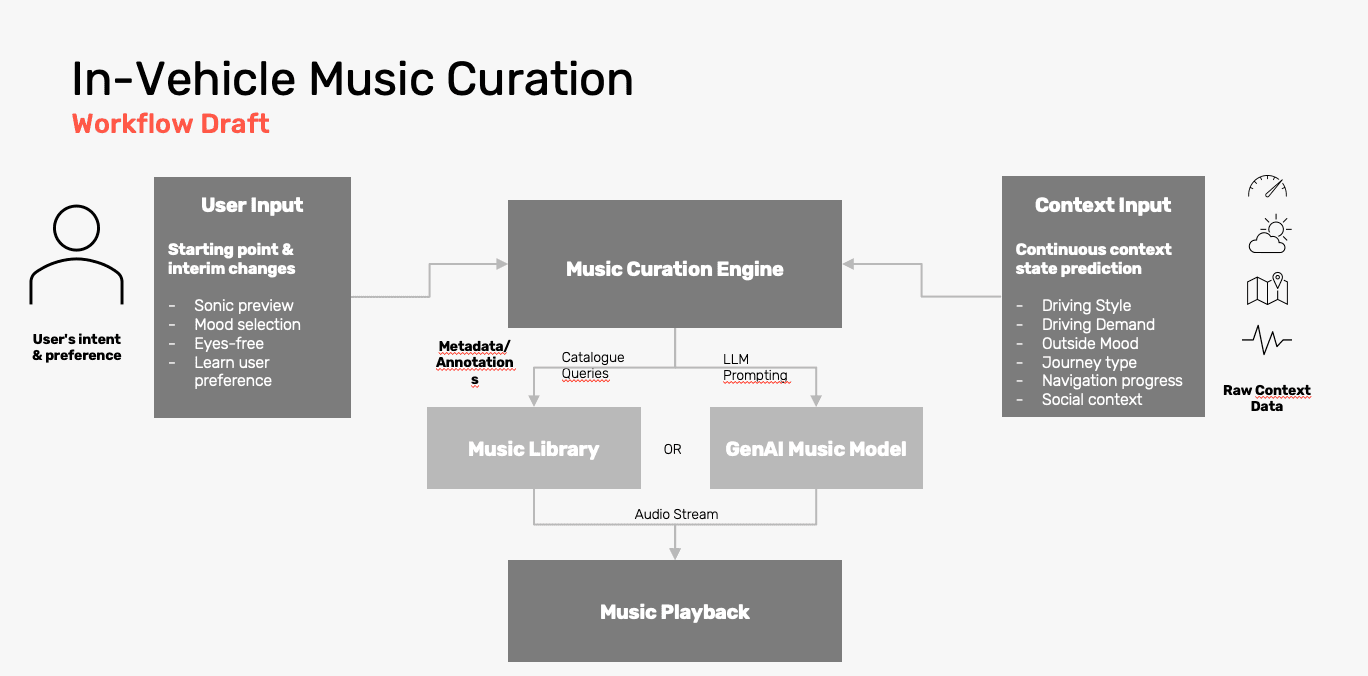


Presentation slides used to pitch to NDA OEM
Positioning of concept in existing market, advanced concept in combination with context curation
Connection between EA's

The FMP is the clearest integration of all expertise areas in my master because the areas did not operate as separate contributions, but as a connected network. Research did not only support U&S; it grounded the design direction, informed the concept, and helped align the work with company values. Likewise, gathering latent customer needs was not isolated from B&E or C&A, but shaped both the business relevance of the direction and the interaction qualities that needed to be designed.
The central design work emerged where multiple areas met: realising the concept through aesthetics, code, sound and hardware. Code and algorithms became aesthetic material, while form, function and interaction had to remain technically feasible and meaningful for users. The high-quality demonstrator then connected T&R, C&A and B&E by making the concept experienceable for experts and stakeholders. The simulator study closed this loop by validating the concept and feeding back into both the user understanding and the design direction.
Together, these areas shaped my professional identity. I moved from a generalist looking for tools toward a multimodal design engineer who can use technology, research, and making to create richer, more embodied experiences.
FUTURE
Relationship between the Expertise Areas
After graduation, I want to develop as a creative technologist / design engineer working with sound, haptics and emerging multimodal technologies, creating digital systems that feel more embodied, meaningful and human. The FMP showed that I can create high-quality experiential prototypes, but also that my next step is to strengthen the path from prototype to market by developing deeper skills in PCB design, embedded C++ and industry-facing product translation.
APPENDIX: COMPANY EVALUATION
This year I had the pleasure of working with Stefan and taking part in feedback rounds for his project. I would like to highlight that our collaboration felt remarkably professional - more like working with an established colleague than with a student completing a master’s thesis.
Throughout the project, we worked closely together across the concept planning, user study, and testing phases. In that process, I was able to witness how Stefan structures his workflow at an exceptionally high level - and I genuinely found myself picking up a few valuable approaches to concept development from him.
What stood out was his dedication, sincerity, and authentic enthusiasm for the subject and the project itself. That energy was clearly felt not only by the users he conducted studies with, but also by the colleagues he shared his progress with - he has a natural ability to draw people in with his creative and expressive approach.
I was pleased to see the high quality of the final outcome - both in its physical and digital execution, as well as in the user experience vision expressed through the concept. Working in the field of interactive music for automotive systems myself, I find his topic highly relevant for the evolving automotive market and the ongoing digitalization of vehicles. The theme and its execution are handled with skill and at a strong level, and I believe it has the potential to bring a meaningful user experience to modern cars.
I hope our paths will cross again professionally - or that, at the very least, I will one day see Stefan’s work reflected in the vehicles of the future.
Maksim Khrychev - Creative Lead, Drivable Music
Working with Stefan during his Master’s thesis project at Impulse Audio Lab was a rewarding experience. Many of our projects are driven by customer requests and technology opportunities, so it was refreshing to see a process that started with research and a genuine focus on understanding user needs. His approach brought a different perspective to the team and led to valuable discussions throughout the project.
Stefan was highly engaged throughout the process and showed a strong ability to balance exploration with practical constraints. He was curious, open to feedback, and consistently looked for ways to refine and strengthen the concept. He also kept the team closely involved through regular presentations and updates, making it easy for us to follow the project’s development and contribute where relevant.
From a business and customer perspective, the topic is highly relevant to the automotive audio industry. The concept explores how music discovery and interaction can become more intuitive and less visually demanding, which is particularly important in a driving context. At the same time, it supports the broader industry trend toward software-based experiences that add value for users without requiring additional hardware.
As vehicles continue to evolve into software-defined products, manufacturers are increasingly looking for digital features that can enhance the user experience and help differentiate their offerings. Concepts like the one Stefan developed fit well within this direction and have clear potential for further development.
The interest shown by industry partners and customers during demonstrations and presentations confirmed that the topic resonates beyond an academic setting. Based on the feedback we received, there is clear interest in the underlying ideas and their potential application in future automotive products. From our side, we see the concept as a promising foundation for further collaboration and development with industry partners.
Jonas Kieser - Business & Product Strategist
During his time at IAL, Stefan contributed to a range of client-facing service projects beyond the scope of his own thesis work.
One particular highlight was his involvement in the sound design process for innovative in-vehicle earcons for a large international automotive OEM. His responsibilities included independent concept development, iterative sound design, and contributing to presentations with the client’s stakeholders.
Stefan proved to be a reliable and engaged collaborator. He worked independently when needed, responded well to feedback, and brought a thoughtful and creative approach to the sound design process.
His contributions were highly appreciated by our team, and it was great to see that the results of his work were also received positively by the client.
Dario Doerfler - Interactive Sound Designer, Audio UX
Sources
Anna Vallgårda. 2014. Giving form to computational things: developing a practice of interaction design. Personal Ubiquitous Comput. 18, 3 (March 2014), 577–592. https://doi.org/10.1007/s00779-013-0685-8
Saskia Bakker, Elise Hoven, and Berry Eggen. 2015. Peripheral interaction: characteristics and considerations. Personal Ubiquitous Comput. 19, 1 (January 2015), 239–254. https://doi.org/10.1007/s00779-014-0775-2
Victoria Bellotti and Keith Edwards. 2001. Intelligibility and accountability: human considerations in context-aware systems. Hum.-Comput. Interact. 16, 2 (December 2001), 193–212. https://doi.org/10.1207/S15327051HCI16234_05
Lisanne Bainbridge. 1983. Brief paper: Ironies of automation. Automatica 19, 6 (November, 1983), 775–779. https://doi.org/10.1016/0005-1098(83)90046-8
Froukje Sleeswijk Visser, Pieter Jan Stappers, Remko van der Lugt, Der Lugt, and Elizabeth Sanders. 2005. Contexmapping: Experiences from practice E.B.N. International Journal of CoCreation in Design and the Arts 1, (April 2005). DOI:https://doi.org/ 10.1080/15710880500135987